



So, you’re having the time of your life and things couldn’t be better. All of those baby teeth have now gone, and you have beautiful permanent dentition after that annoying period of orthodontics. The difficult years of early teens has gone by and life is going well.
Uh oh; what is that lump and irritation occurring behind my back teeth?
This is a common scenario for adolescents experiencing for the first time the discomfort of eruption of the third molars (wisdom teeth). If left unattended, this discomfort has the potential to cause serious disruption to one’s life.
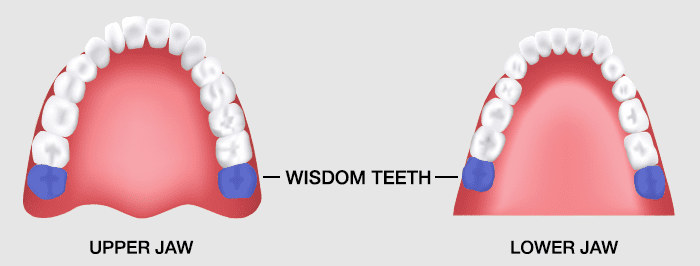
It is interesting to note that the evolutionary dento-facial trend is for a reduction in the number of wisdom teeth that we see per capita of the population. This evolutionary trend is a continuation of modern man’s lifestyle direction, where once we had four molars in each quadrant of our mouth (still occasionally seen) it is now more prevalent to see fewer than three molars per quadrant (for more information on tooth anatomy click here).
It is now common to see our adolescent population with fewer than the expected four wisdom teeth, however these teeth can and often cause serious problems to the existing permanent dentition. It is unusual for a person to be able to accommodate their erupting wisdom teeth, due mainly to a discrepancy between tooth size and jaw size.
Symptoms of a wisdom tooth being unable to erupt into normal occlusal function (erupt at the correct angle with enough room) include:
- Redness and swelling behind the second molar.
- Frustrated healing of the soft tissue over the crown (top) of the wisdom tooth.
- Swelling in the pharyngeal regions (side throat area) and at the angle of the mandible (side of the jawbone).
- Inability to bite together.
- Pressure on adjacent teeth.
- Pre-disposition to decay on both the wisdom tooth and the second molar (due to food compaction).
- Rotation and mal-alignment of the dentition with potential ill-effects post orthodontic treatment (tooth movement due to eruption forces of the wisdom teeth).
- Referred pain to the TMJ (temporomandibular joint – just in front of your ear).
- Disturbance (pain) in the muscles of mastication (your ‘chewing’ muscles, around your jaw).
Types of impactions include:
- Normal vertical, or upright, impactions
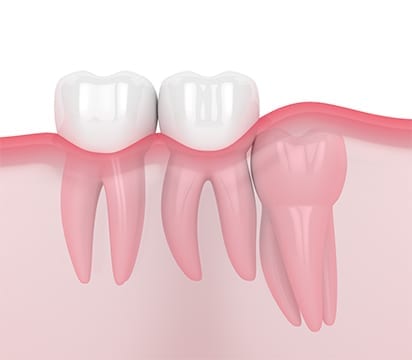
- Mesio-angular impactions (where the tooth is leaning forward and creates a pocket behind the second molar)
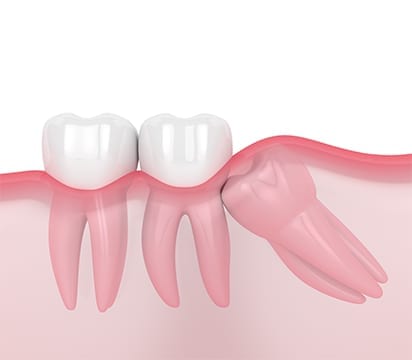
- Disto-angular impactions (where the tooth is leaning backwards into the body of the mandible). These are more difficult to extract due to the required amount of bone removal.

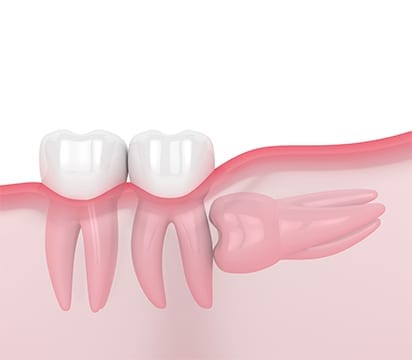
- Horizontal impactions (where the wisdom tooth is lying completely flat, and the top of the crown is usually resting against the back of the second molar). These teeth lay at right angles to the rest of the dentition.
Whilst it would be nice to be able to avoid surgical removal of wisdom teeth, the unfortunate fact is that rarely do these problems go away and it becomes inevitable that these teeth must be surgically removed to allow people to resume their quality of life.
Fortunately, the team at VC Dental are very experienced in this area, and we treat a large number of adolescents with these problems every year. We have found a strong patient preference to having all wisdom teeth removed in one appointment where our seditionist medical practitioner provides an intravenous sedation, allowing the patient to sleep while all teeth are comfortably removed. The patient has no knowledge or recollection of any surgery involved, however must adhere to the advised post-surgical protocols. For more information on our sleep dentistry service click here.
If you have any concerns regarding wisdom teeth development, please contact our friendly team who will arrange for you to have a consultation with one of our dentists. We have the facilities available to take a panoramic x-ray image so we can assess your exposure to wisdom teeth complications and guide you through this important chapter in your life.
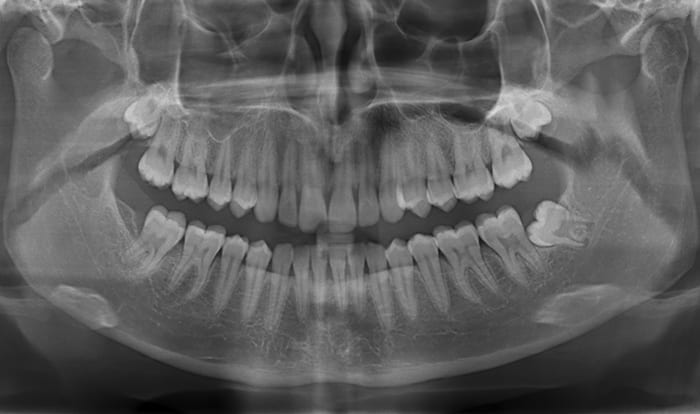
A panoramic (whole mouth) x-ray image, also called an OPG, provides excellent diagnostic imagery of impacted wisdom teeth and the adjacent anatomical structures.
The below image is an example of a panoramic x-ray:
For more information on our Wisdom Teeth services please click here.
Please note, any surgical or invasive procedure carries risks. Before proceeding you should obtain personal advice from an appropriately qualified health practitioner.